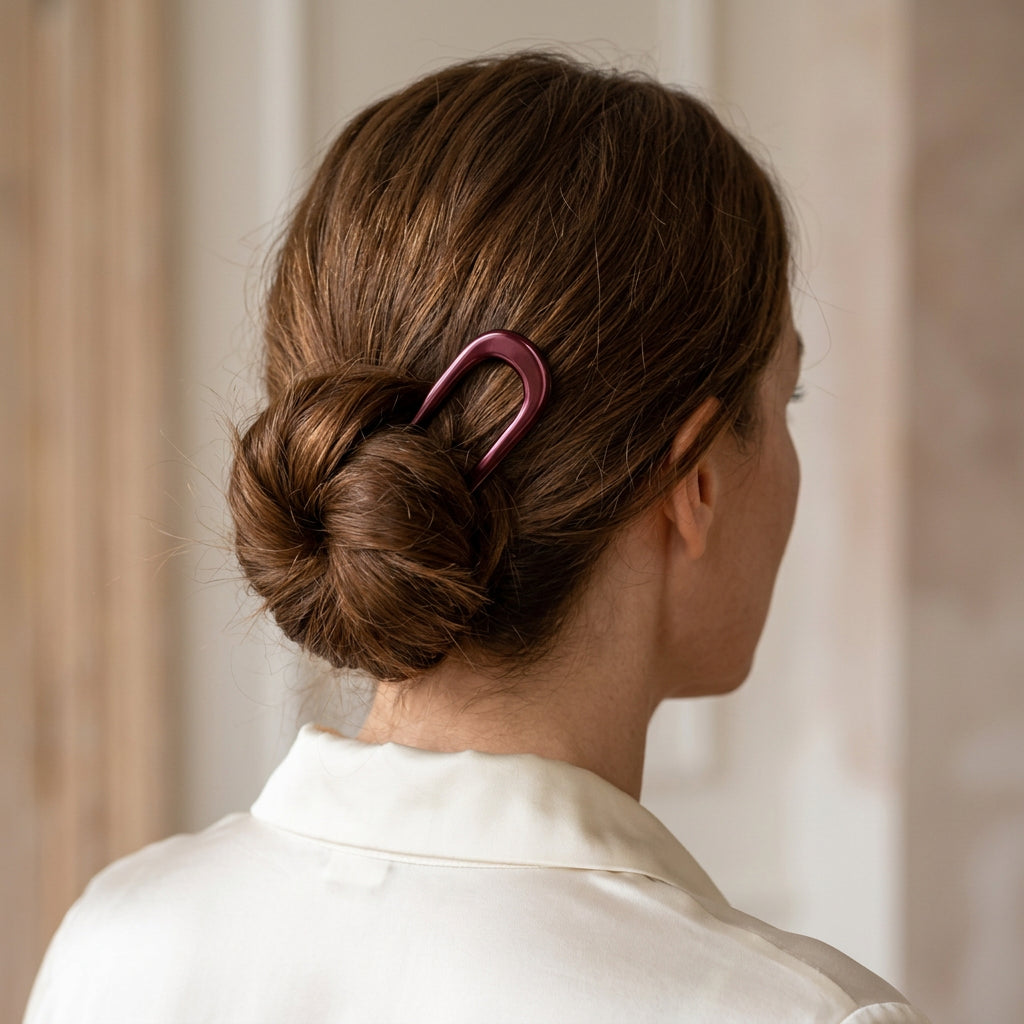
Bordeaux Sculpted Two-Prong Hair Fork for Twisted Buns and Understated Updos
Bordeaux Sculpted Two-Prong Hair Fork for Twisted Buns and Understated Updos
Couldn't load pickup availability

Bordeaux Sculpted Two-Prong Hair Fork for Twisted Buns and Understated Updos
🎐 The Updo, Reduced to Two Lines and a Curve
Some hair accessories become the entire story. The Bordeaux Sculpted Hair Fork takes another approach. An elongated arch, two slender prongs and a deep wine finish offer a small, deliberate accent within the hair rather than a decoration placed over it. The shape is continuous, the surface is unbranded and the design leaves room for the bun itself to remain visible.
On the dressing table, it reads almost like a small sculptural object. In an updo, much of the form disappears into the arrangement, leaving the rounded upper curve to catch the light. That change between the complete object and the visible detail is part of its appeal: a useful tool whose design does not need to announce every part at once.

Scene One: The Shape Before the Style
The fork is formed as one elongated U, with two separated prongs descending from a closed curved top. There is no hinge, clasp, spring or decorative stone. The ends are rounded rather than needle-like, continuing the smooth outline found at the arch. Look along the length and the narrow proportions are clear; this is not a wide comb with a row of many teeth.
The bordeaux color changes in emphasis with the light, appearing deeper through the center and brighter along the curved edges. Its polished appearance brings contrast to a soft hair arrangement without adding a printed pattern. The color name refers to the wine-toned finish; no claim about a particular precious metal or coating technology is needed to appreciate the visual effect.
Scene Two: Begin with Hair You Can Arrange Comfortably
A fork needs an arrangement to hold within, so the preparation comes before insertion. Gather a workable amount of hair and decide where you want the bun to sit. A lower placement may be easier to see and reach while you are learning. Avoid twisting so tightly that the hairline or roots already feel strained before the tool is added.
Length, density and texture all change how much hair can be arranged at once. Hair needs enough usable length to form a twist or bun with a path for the prongs. Shorter layers may remain loose, and very dense hair may call for a smaller partial updo rather than one large bundle. Treat the first attempt as a chance to learn the relationship between your hair and the fork.
A Starting Sequence for a Relaxed Twisted Bun
- Gather the intended section with your hands, keeping the hairline comfortable and the remaining lengths visible.
- Twist gently and arrange the length around itself into a bun shape. Hold the arrangement with your free hand rather than expecting the tool to create the bun for you.
- Bring the two prongs to the edge of the arrangement, keeping their direction visible and away from the scalp.
- Guide them through a small part of the outer twist and into the supporting hair beneath, using a shallow, controlled path. Stop if there is resistance or pressure.
- Release your supporting hand slowly and check whether the bun sits comfortably. If it feels loose or tight, remove the fork and adjust the arrangement instead of pushing harder.

Scene Three: Let the Arch Become the Accent
The finished look does not require the entire fork to remain visible. In a comfortable placement, the prongs may sit within the arrangement while the curved top appears near its edge. You can choose how much of that curve is visible by changing the angle of the bun and the path you use, provided the placement stays gentle and stable for your hair.
For a quieter result, keep the visible arch close to the twist. For a more pronounced accent, allow a little more of the upper form to show. These are styling decisions rather than promises about holding strength. The fork should never be bent into a different shape or forced against the head to achieve a particular photographic angle.
When the First Attempt Needs Another Try
If the fork slides out: undo the placement and consider whether the prongs passed only through the loose outer twist rather than supporting hair as well. Rework a smaller, more manageable arrangement instead of adding tension at the roots.
If the bun feels tight: support it with one hand and withdraw the fork gently. Loosen the twist before trying again. A sleek appearance is not a reason to accept scalp pressure.
If shorter layers escape: decide whether to leave them loose as part of the style or choose a different section. Not every length can be secured by the same bun shape, and a single fork is not a guarantee that all layers will stay in place.
A Different Tool from a Clip
A spring clip closes around hair; this fork does not. Its role depends on how the prongs travel through the arrangement you have made. That makes technique and hair length important, and it also gives the accessory a simpler external silhouette. There is no fastening to hide beneath a decorative cover.
Choose it when you enjoy arranging a twist by hand and want an understated visible accent. It is not a detangling comb, a heated styling tool or a promise of all-day hold during every activity. Remove it when its position could press against your head, catch on equipment or become uncomfortable.

The Release Is Part of the Ritual
Support the bun before withdrawing the fork. Follow the direction of the placement gently rather than twisting the tool sharply through the hair. Let the arrangement loosen in your hand, then separate the lengths with care. If a strand has caught, free it before continuing instead of pulling the entire fork against it.
A Sleeve, Not Another Box to Store
The presentation pairs one bordeaux two-prong fork with a plain sand-colored fabric sleeve. The fabric gives the accessory its own place without adding an ornate rigid box. Store the fork only when dry, keep its prongs protected from heavy objects and avoid loose sharp accessories that could scratch the finish or catch the sleeve.
For light surface care, use a soft cloth. Avoid abrasive pads, strong cleaning agents and bending the prongs to change their spacing. Inspect the ends before use and discontinue use if damage creates a rough or sharp area.
Included: one wine-burgundy two-prong hair fork and one plain fabric sleeve. Additional pins, hair ties and styling props are not included. Will it fit every length? No; the hair must form an arrangement the prongs can engage comfortably. Choose it for the clarity of the design and the pleasure of learning a more deliberate updo.