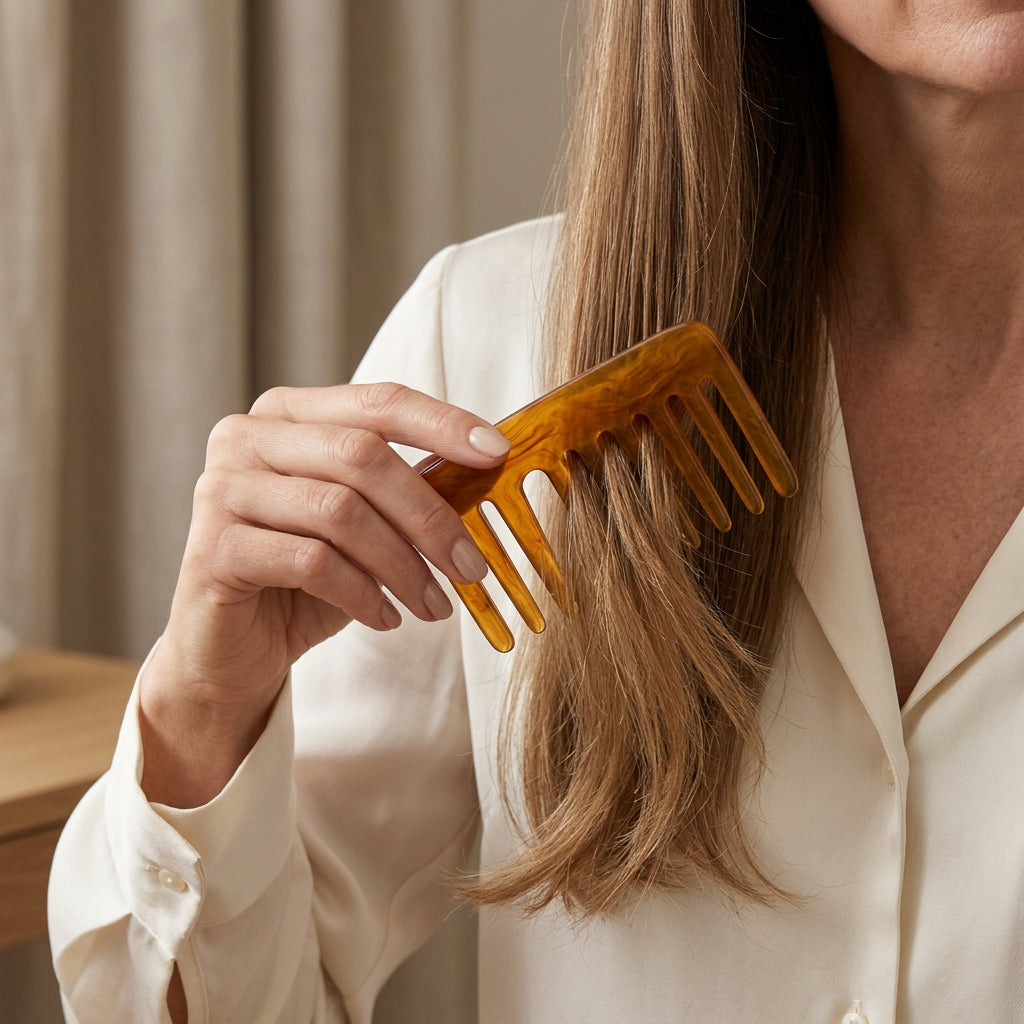
Amber Arc Wide-Tooth Styling Comb with a Sculpted Spine and Rounded Teeth
Amber Arc Wide-Tooth Styling Comb with a Sculpted Spine and Rounded Teeth
Couldn't load pickup availability

Amber Arc Wide-Tooth Styling Comb with a Sculpted Spine and Rounded Teeth
🍯 Warm Light, Open Space, a More Deliberate Comb
Honey amber has a particular presence on a dressing table. It catches the light along an edge, deepens through a thicker curve and reveals a quiet marbled pattern when you look closely. The Amber Arc Wide-Tooth Styling Comb brings that visual character to a simple, useful form: a continuous arched spine, widely spaced teeth and rounded ends. There is no separate handle to interrupt the shape, no printed branding and no ornament competing with the color.
This is not a fine finishing comb disguised in a different shade. The generous spaces between the teeth give it a clearly different working surface from a close-toothed tail comb. It is a manual tool for separating and arranging manageable sections of hair, with an uncomplicated outline that is just as considered when lying flat as when held in the hand.

The Object: One Continuous Silhouette
Follow the upper edge from one corner to the other. The spine rises in a gentle curve, then meets softly rounded outer corners rather than abrupt square ends. Beneath it, the teeth descend in a regular open pattern. The transitions between the teeth are rounded too, continuing the visual language of the exterior instead of adding sharp internal angles.
The amber effect is most noticeable at the edges and through the thicker spine. Light passes differently through those areas, making the comb read as layered rather than flatly colored. The marbled appearance is a visual finish, not a claim that the product is carved from natural amber. What matters here is the relationship between the warm tone and the clean, open geometry.
The Grip: Hold the Spine, Leave the Teeth Free
Because there is no long handle, your hand meets the upper part of the comb directly. Hold the spine in a relaxed way, with enough room to change its angle as you move through a section. Avoid gripping across the teeth or using the tips as leverage. You should be able to stop and reposition the comb without twisting it sharply against resistance.
A useful first check is to hold a small, loose section in your other hand and bring the comb to the ends. Notice whether the section moves freely through the spaces. If the hair bunches into a knot, reduce the amount you are working with rather than tightening your grip. Wide spacing does not make pulling through a tangle a good idea.
The Movement: Work Up from the Ends
- Separate an area you can comfortably control, keeping neighboring hair out of the way.
- Support the section above the place where you are working so a small snag does not become a hard pull at the roots.
- Begin near the tips with short, gentle passes. Pause if the comb stops moving freely.
- Once the lower lengths are clear, begin a little further up. Repeat gradually rather than starting at the scalp and dragging down through everything.
- Finish by arranging the section in the direction you prefer, then move on to the next area.

Choose the Moment, Not Just the Tool
Hair texture and the finish you want should guide when you comb. If your aim is to preserve a particular curl arrangement, consider how combing fits the routine you already use; passing teeth through the hair can change that arrangement. If you are preparing lengths to gather into an updo, separate the area first and work with the hair's current condition instead of assuming the same approach suits every day.
For dense hair, use more sections rather than filling every gap in the comb with a large bundle. For long hair, keep the lower lengths visible so you can see where a snag begins. Around shorter layers, reduce the size of the movement and avoid catching loose strands from another area. Small adjustments in preparation are more useful than repeatedly forcing the same pass.
Space Between the Teeth, Space in Your Routine
The wide-tooth format is different from both a bristled brush and a small detail comb. It is not intended to create fine partings with a pointed tail, wind hair around a barrel or brush a tiny hairline section into a sharply defined curve. Its place is the broader task of working through and arranging selected lengths by hand.
That distinction makes it a useful visual and practical counterpart to more specialized styling tools. You can choose it for the stage where you want open spacing, then move to another tool if your chosen finish calls for one. There is no need to ask a single comb to perform every step, and no electrical feature to learn before you begin.

Care for the Teeth, Not Only the Surface
After use, remove loose strands from the spaces and inspect the tooth tips. If a tooth becomes damaged or develops a rough edge, stop using the comb rather than continuing to pass it through the hair. For light surface care, begin with a soft damp cloth and dry the comb before putting it away. Avoid abrasive pads, strong solvents, direct heat and using the comb as a lever to open or pry objects.
Store it where the teeth are not carrying the weight of other tools. The plain beige fabric envelope provides a separate place for the comb, keeping the presentation simple without an additional rigid gift box. Let the comb and sleeve dry fully before storing them together, and keep sharp accessories from catching the fabric or scraping the finish.
Before You Make It Yours
Included: one amber-finish wide-tooth styling comb and one plain beige fabric sleeve. Towels, decorative vessels and other setting props are not included.
Is it a fine-tooth comb? No; the working spaces are deliberately wide. Does it contain natural amber? The name describes the color and visual finish, not a gemstone material claim. Does it need power? No. Should a stubborn knot be pulled through? Stop, separate the section and continue gently only when the comb can move without force.
A warm color, a strong silhouette and an open working surface. Choose Amber Arc for the part of getting ready that deserves a little less rushing and a little more attention.